New Puzzle Games for PC - Page 53

Maxwell's Maniac
1992
Maxwell's Maniac
1992
Maxwell's Maniac is a computer game originally part of the Microsoft Entertainment Pack series. Loosely based on the concept of the Maxwell's Demon thought experiment, the object of the game is to separate the red and blue molecules into their respective color-coded chambers using a sliding door. It is superficially similar to JezzBall in layout.Tic Tac Drop
1992
Tic Tac Drop
1992
Tic Tac Drop is a puzzle video game developed and published by Microsoft in the Microsoft Entertainment Pack 4 for Windows 3 in 1992. The game is a rendition of Connect Four but with several additional features like the ability to customize the size and shape of the play field as well as the length of line needed to win.Go Figure!
1992
Go Figure!
1992
In "Go Figure!", the player is given a selection of four numbers and they must use addition, subtraction, multiplication and division to devise a calculation that will match a target number. The player scores points for every equation they solve within the game's time limit. There are skill levels, a hint function and a high score table.Box World
1992
Box World
1992
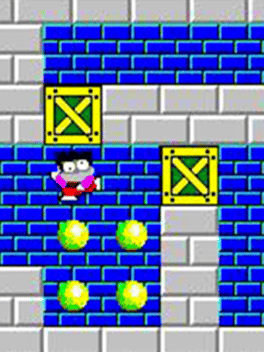
Box World is a single player puzzle video game for Windows 3.1, created and published by Jeng-Long Jiang in 1992.Pensate
1992
Pensate
1992
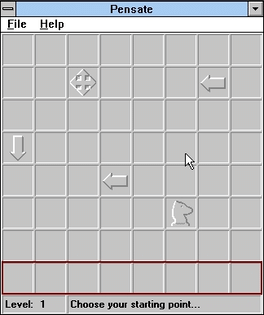
Pensate is a single-player, shareware, strategy/puzzle, turn based game that is based on the 1983 game by Penguin Software. This implementation is played on an 8x8 board and has ten levels. The players objective is to navigate their piece from the bottom of the board to the top, their token can only be moved horizontally or vertically. Also on the game area are opposing pieces which behave like chess pieces which move position every time the player makes a move, so the migration from the bottom of the screen to the top is complicated by the need to avoid being captured by these pieces.Kye
1992
Kye
1992
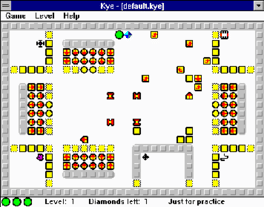
Kye is a real-time puzzle game with a variety of interacting objects. It takes ideas from puzzle games like Sokoban and Boulder Dash, but the inclusion of active objects gives it a real-time component, and it can also produce arcade-game levels like those found in Pac-Man. Anyone can create new levels for the game.CyberSpace Crossword Puzzle
1992
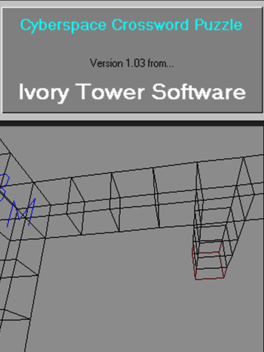
CyberSpace Crossword is a freeware three dimensional crossword puzzle. The player starts at a point in cyberspace some distance above the puzzle and navigates to it using three slider controls that adjust the player viewpoint in each of the three dimensions. Upon nearing the puzzle the game begins and the player is offered the first clues. Cell 1 is preselected for the player to enter a letter. None of the cells are numbered, however when selected a cell changes colour and any associated clues are displayed in a window in the lower right corner of the game area. Answers are entered letter by letter and to do this the player must select each cell individually, enter a letter, then select the next cell, enter the next letter and so on.Klotski
1991
Klotski
1991
Klotski is an ancient Polish game that provides mathematical problems in the form of a small wooden game board with various sized blocks. The object of the computer game is to free the "master block," in as few moves as possible. The computer scores you on the number of moves it takes to solve a puzzle. 24 puzzles are included, as well as a puzzle editor.Stones
1991
Stones
1991
Stones is a game developed by Michael C. Miller and released in 1991 as part of Microsoft's Windows Entertainment Pack. The object is to place 90 tiles, or "stones", on a board. A tile can only be placed if it shares two of three attributes - background color, character color, or character shape - with every adjacent tile. Wild tiles may be placed anywhere regardless of attributes. The game is won when all tiles are placed or when there are no valid spaces to place the next tile.WordZap
1991
WordZap
1991
star 4.7WordZap is a puzzle video game designed by Michael Crick included with Volume 3 of the Microsoft Entertainment Pack. In WordZap, players race to make proper English words to fill their rack of words, but when one player makes a word already found by the other player, the word is "zapped" from both players' racks. Each round ends when either one player fills the word rack, or time runs out without either player being able to make another word.Daffy Duck, P.I.: The Case of the Missing Letters
1991
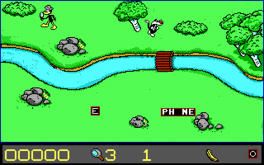
Daffy Duck, PI - The Case Of Missing Letters is a Puzzle game, developed by RSP and published by Psygnosis, which was released in 1991 for the PC.Rodent's Revenge
1991
TetraVex
1991
TetraVex
1991
TetraVex is a puzzle computer game, available for Windows and Linux systems. TetraVex was originally available for 16-bit Windows in Windows Entertainment Pack 3. It was later re-released as part of the Best of Windows Entertainment Pack. TetraVex is also available as an open source game on the GNOME desktop as part of the GNOME Games collection under GNU GPL. A 32-bit Windows version was written in Delphi by Mark Billig. The original version of TetraVex (for the Windows Entertainment Pack 3) was written (and named) by Scott Ferguson who was also the Development Lead and an architect of the first version of Visual Basic. TetraVex was inspired by "the problem of tiling the plane" as described by Donald Knuth on page 382 of Volume 1: Fundamental Algorithms, the first book in his The Art of Computer Programming series.Paganitzu Part 2: The Silver Dagger
1991
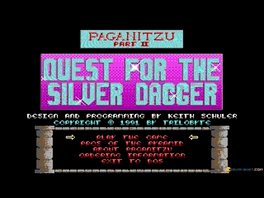
Paganitzu is a tile-based, CGA/EGA computer game created by Keith Schuler and published by Apogee Software in October, 1991. It is the sequel to Chagunitzu. The game is a 2D puzzle game comparable to Chip's Challenge. It requires the player to solve various puzzles to complete the game. Paganitzu was published in three parts. Part 1: "Romancing the Rose", Part 2: "The Silver Dagger" and Part 3: "Jewel of the Yucatan".Paganitzu Part 3: Jewel of the Yucatan
1991
Paganitzu is a tile-based, CGA/EGA computer game created by Keith Schuler and published by Apogee Software in October, 1991. It is the sequel to Chagunitzu. The game is a 2D puzzle game comparable to Chip's Challenge. It requires the player to solve various puzzles to complete the game. Paganitzu was published in three parts. Part 1: "Romancing the Rose", Part 2: "The Silver Dagger" and Part 3: "Jewel of the Yucatan".Paganitzu Part 1: Romancing the Rose
1991
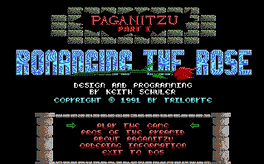
Paganitzu is a tile-based, CGA/EGA computer game created by Keith Schuler and published by Apogee Software in October, 1991. It is the sequel to Chagunitzu. The game is a 2D puzzle game comparable to Chip's Challenge. It requires the player to solve various puzzles to complete the game. Paganitzu was published in three parts. Part 1: "Romancing the Rose", Part 2: "The Silver Dagger" and Part 3: "Jewel of the Yucatan".Jigsawed
1990
Jigsawed
1990
JigSawed is a puzzle video game developed by Tito Messerli and published by Microsoft in Microsoft Entertainment Pack 2 for PC in 1991. The game is a simple jigsaw puzzle, only it uses primitive shapes instead of standard fully-interlocking jigsaw shapes.Pegged
1990
Pegged
1990
Pegged is a puzzle video game developed by Mike Blaylock and published by Microsoft in their Microsoft Entertainment Pack for Windows for Windows 3 in 1990. It is a video game version of various layouts of peg solitaire.Tetris
1990
Tetris
1990
Tetris is a Windows port of the game included as part of the first Microsoft Windows Entertainment Pack, and later re-released as part of Microsoft's Best Of Windows Entertainment Pack.Microsoft Minesweeper
1990
star 6.9Microsoft Minesweeper (formerly just Minesweeper, and also known as Flower Field) is a minesweeper-type video game created by Curt Johnson, originally for IBM's OS/2, that was ported to Microsoft Windows by Robert Donner, both Microsoft employees at the time.